RTP Pokies in Australia: Understanding the Figures
 Available in AU
RTP describes a game’s theoretical return over extensive play, while settings and randomness mean it cannot predict an individual session.

- What a High RTP Figure Actually Tells You
- RTP Claims in the Australian Market: The Legal Setting
- Online Access Does Not Make an RTP Claim Verifiable
- Why the Highest Published RTP Is Not a Guarantee
- RTP and Payouts Are Different Measures
- What “Australian Pokies RTP” Can—and Cannot—Mean
- Pokies RTP: The Role of Randomness
- High RTP Online: Configuration and Oversight
- How to Read a Claim About the Highest RTP
- RTP in Practice: Limits of the Percentage
What a High RTP Figure Actually Tells You
RTP, or return to player, is a theoretical measure of the share of stakes a pokie is designed to return over a very large volume of play. It is not a forecast for a particular session. The figure describes the game’s mathematical return setting, not a schedule of winnings or a promise that a certain amount will come back after a certain number of spins.
That distinction is easy to lose when a percentage is presented as a headline. “High return” sounds like a description of what will happen in play. In practice, it describes a model. The percentage can help compare stated settings, but only when the figures refer to the same version of the game and are being read on the same basis.
I used to see promotional copy turn a technical figure into a sales shorthand. The number looked decisive; the qualification behind it was less visible. A published RTP can tell something about the game’s long-run design, but it does not tell the whole story of the version currently offered or how play will unfold.
RTP is one factor to consider when choosing pokies, but it is worth checking what is known about each casino before you play. This guide offers a concise reference to the listed operators for Australian players in 2026.
License: Curacao eGaming OGL/2023/174/0082 (Dama N.V.) · Min. deposit: A$15 LevelUp Casino lists a Curacao eGaming licence held by Dama N.V. Its minimum deposit is A$15.
License: Curacao · Payout speed: crypto 30-60 minutes, fiat 1-5 days · Min. deposit: A$10 Wild Tokyo lists a Curacao licence and a minimum deposit of A$10. Its stated payout times are 30–60 minutes for crypto and 1–5 days for fiat.
License: Curacao Gaming Control Board OGL/2023/176/0095 (Hollycorn N.V.) LuckyVibe lists a Curacao Gaming Control Board licence, OGL/2023/176/0095, held by Hollycorn N.V.
License: Curacao Gaming Control Board OGL/2023/176/0095 (Hollycorn N.V.) Rollero Casino lists a Curacao Gaming Control Board licence, OGL/2023/176/0095, held by Hollycorn N.V.
License: Curacao eGaming (Dama N.V.) JeetCity Casino lists a Curacao eGaming licence held by Dama N.V.
License: Curacao eGaming OGL/2024/923/0383 (Antillephone N.V.) · Min. deposit: A$30 WinSpirit Casino lists a Curacao eGaming licence, OGL/2024/923/0383, held by Antillephone N.V. Its minimum deposit is A$30.
License: Curacao (operating since 2017) · Min. deposit: A$20 Uptown Pokies is listed as operating since 2017 under a Curacao licence. Its minimum deposit is A$20.
License: Curacao · Min. deposit: A$20 (POLi) Lucky Dreams lists a Curacao licence and a A$20 minimum deposit via POLi.
License: Curacao eGaming (Roby Games Ltd) Roby Casino lists a Curacao eGaming licence held by Roby Games Ltd.
Payout speed: crypto under 1 hour, PayID 1-3 business days · Min. deposit: A$20 (A$30 to qualify for the bonus) Ricky Casino lists crypto payouts in under an hour and PayID payouts in 1–3 business days. The minimum deposit is A$20, or A$30 to qualify for the bonus.
The setting matters
A specialist review reports that some providers let casinos choose from multiple RTP settings for a particular pokie. As a result, one game may carry different published return percentages at different casinos. The game’s name alone is not enough to identify its setting.
That is why a figure copied from a provider’s general game description may not establish the return setting in a specific casino. The relevant question is not simply whether a game has a high listed RTP, but which setting applies to the version being offered. A comparison that ignores this can place unlike versions side by side and make the difference look like a property of the game’s title rather than its configuration.
The distinction is practical, not cosmetic. When a figure is attached to a named game, it can appear to be a fixed attribute, like its theme or layout. Where settings are selectable, however, the figure belongs to a particular configuration. The same title may therefore be described accurately in one place and differently in another, without either description necessarily referring to the same setup.
A careful claim makes its scope clear: it identifies the game version or setting to which the percentage refers. If that detail is absent, the number is incomplete as a basis for comparison. A bare percentage is not self-explanatory.
What comparison can show
A stated RTP can be useful when comparing games or versions, provided the figures are specific and comparable. It gives a common measure of theoretical return. That can help distinguish one published setting from another, but it cannot rank games in every respect. RTP does not, on its own, describe how often wins occur, how large they are, or how play feels.

Those are separate characteristics. Two pokies with similar stated returns may have different patterns of play; a higher figure does not automatically mean a more suitable experience. Nor does a comparison based on RTP alone establish that one game is better in every meaningful sense. It answers a narrower question: what return percentage is stated for the configuration being compared?
This matters when a page labels a selection as the best high-RTP pokies. The label may suggest a straightforward contest, but the underlying comparison depends on the exact settings and the criteria used. If the listed figures come from different versions, the ordering can be misleading. If the settings are not identified, the ranking may look more precise than the information allows.
There is a difference between a figure that is mathematically meaningful and a claim that is sufficiently specified. The former is a property of a model; the latter needs enough context to show what model is being described.
Read the number as a description
RTP should be read as a theoretical return measure attached to a game setting, not as a personal outcome indicator. Each spin is determined independently by a Random Number Generator, so the percentage does not map out the result of a particular run of play. The figure works at the level of the game’s design over extensive play, not as a promise about when results will arrive.
That makes the number useful, but limited. It can describe a stated configuration and support a like-for-like comparison when the setting is known. It cannot tell whether a particular session will finish ahead, or convert a long-run measure into a short-term expectation.
Attention: RTP is a theoretical measure of a game’s design over extensive play, not a promise or forecast for any particular session.
In my experience, the most revealing detail is often not the headline percentage but the small qualification beside it: which version, which setting, and what exactly the figure describes. Without that context, a high figure is a starting point for interpretation, not a complete verdict.
The distinction is plain. A percentage describes the model. It does not settle the experience.
RTP Claims in the Australian Market: The Legal Setting
In Australia, a published RTP figure sits against an unusual legal background: real-money online pokies cannot lawfully be offered to people in the country by an operator without a domestic licence, and no domestic licences for that service have been issued. There is no Australian-licensed online casino. That matters when interpreting a return claim because the figure is not backed by a local online casino licensing framework.
The Interactive Gambling Act 2001 places the restriction on companies providing the service. In practical terms, a site’s presentation of a pokie and its stated return percentage does not establish that the operator is authorised to offer real-money play in Australia. Nor does an Australian-facing page, a familiar game title or a polished description change the licensing position. Those details may tell something about how a service presents itself; they do not create a domestic licence.
I have seen how easily two separate questions get compressed into one. The first is whether a game has a published RTP. The second is whether the casino offering it has a legal basis to serve Australian customers. A figure can look precise and still answer only the first question. It is not proof of local authorisation, and the existence of a stated percentage should not be mistaken for a domestic regulator’s endorsement of the operator.

That distinction is particularly important where a page uses reassuring language such as “trusted” or “Australian-friendly”. The advertising word is doing work; it can suggest familiarity or suitability without demonstrating legal status. I read the substance behind the label: a claim about a game’s return is not the same thing as a local licence to offer that game for real money. Different questions. Different evidence.
The absence of an Australian-licensed online casino also changes what local protection can be expected if a dispute arises. If an offshore casino refuses to pay winnings, Australian players have no legal recourse in Australia. That is a material limitation, not a footnote to an RTP comparison. A percentage may describe a theoretical property of a game, but it does not itself provide a route to enforce a payment or resolve a disagreement with an offshore operator.
This is why legal context belongs beside any discussion of pokies RTP in Australia, rather than being treated as a separate administrative detail. A return figure may attract attention because it appears measurable. The operator’s legal position determines a different matter: whether the service is authorised to provide real-money online casino games to people in Australia. Mixing those questions gives the percentage more authority than it carries.
I would not read an RTP statement as a certificate of compliance. A number printed beside a game is a representation made in the context of that particular service. It does not, by itself, tell whether the company is permitted to offer online pokies here, whether an Australian authority has approved the offering, or whether a local remedy exists if the operator disputes a withdrawal. Those are not conclusions that follow from the percentage.
Legal Risk
There are no Australian-licensed online casinos; players using offshore sites have no legal recourse in Australia if a dispute arises.
The reverse is also worth keeping clear. The legal restriction on operators does not, by itself, show that every RTP statement made offshore is inaccurate. It means the claim must be understood without assuming a domestic online casino licence or the protections that might be associated with one. Accuracy of the figure and legal authority to provide the game are separate matters; one cannot stand in for the other.
In industry terms, compliance language and product language often sit close together on a page, but they do different jobs. “High return” describes a game-related claim. “Licensed” would describe a legal status, and in this market there is no Australian online casino licence for an operator to hold. A page can make the first statement without resolving the second. The neat layout does not join them.
For the same reason, a list presented as the best RTP pokies for Australians should not be read as a list of locally licensed products. The label may describe the intended audience or the subject of the comparison; it does not establish a domestic licensing category. The legal position remains the starting point for judging what an operator can lawfully offer, while an RTP claim remains a separate statement about the game.

That is the boundary I keep in view when assessing these claims: a displayed return percentage is not a substitute for legal authority, and it cannot supply Australian legal recourse where none exists. Clear distinction. No implied endorsement.
Online Access Does Not Make an RTP Claim Verifiable
A site loading in Australia establishes only that its pages can be reached. It does not establish that the operator is dependable, that a published return figure belongs to the version of the game being offered, or that the figure has been independently checked. Access and verification are separate questions.
The distinction matters in this market because the Interactive Gambling Act targets the companies providing online pokies, rather than individual players. Australians may legally play on offshore sites that accept them, but that does not make those services locally licensed or bring them under Australian casino oversight. A site’s willingness to accept Australian customers is not a quality mark. It is simply a decision made by the operator.

I have seen how easily a clean-looking game page can make a claim feel settled. A return percentage may be displayed beside a title, surrounded by polished graphics and confident language. The presentation can look precise while leaving the important question unanswered: what, exactly, supports the figure shown for that game on that site? The number itself is not proof of the operator’s reliability.
That is why “verified” needs careful handling. It can mean that a figure appears on a page, that an operator says it applies, or that some external process has checked it. Those are not interchangeable statements. Without a clear account of what was checked and who stands behind the claim, the label tells little about the strength of the evidence. Confident wording is not independent confirmation.
Nor does accessibility provide a practical remedy if the relationship breaks down. If an offshore casino withholds winnings, a player cannot take the dispute to an Australian court and rely on local legal recourse against that operator. The difference between being able to open a site and being able to enforce a claim against it is substantial. It is easy to overlook until money is at stake.
Being able to access a site in Australia does not mean the operator is locally licensed or that their published return figures have been independently verified.
This is the part that promotional copy tends to smooth over. “Available to Australian players” describes the operator’s acceptance of customers; it does not describe the protections available to those customers. Likewise, a published return percentage describes a claim about a game, not the standing of the business displaying it. One statement cannot fill the gap in the other.
I would therefore read an online RTP figure as information presented by the site, not as a conclusion about trustworthiness. The same caution applies to badges and broad assurances: their presence does not, by itself, explain what has been examined or what happens if the operator disputes a withdrawal. The wording may be reassuring. The underlying accountability is a different matter.
This is not a claim that every offshore site behaves in the same way. It is a limit on what can reasonably be inferred from access. A working page, an Australian-facing offer and a prominent percentage do not establish a reliable operator or a locally enforceable promise. In this market, those details should not be bundled together as if one proves the others.
Access is not assurance.
Why the Highest Published RTP Is Not a Guarantee
A high published RTP can look like a clear reason to expect a better result. The figure is useful for describing a game in theoretical terms, but it does not tell anyone what will happen in a particular session. “Highest” sounds decisive; in practice, it describes a comparison of stated percentages, not a promise attached to the next spin.

I learned to separate those two ideas when looking at game information from the operator’s side. A return percentage is not a personal forecast. It does not mean that a player will receive a matching share of their stake back, nor does it set a minimum return for a session. The figure describes an overall theoretical outcome, while an individual can finish ahead, behind, or without a return during the play in question.
That distinction matters especially when a title is promoted as one of the highest-returning pokies. The wording can make a statistical measure feel like a practical advantage that will show up immediately. It will not. The label cannot identify when a win will arrive, how large it will be, or whether a particular player will see one at all. Those are not details contained in the headline figure.
Every spin is generated separately through a Random Number Generator. In other words, the outcome of one spin does not make the next one due to compensate, repeat, or follow a pattern. A run of losses does not create a debt that the game must repay. A recent win does not establish that another is likely to follow. Each result stands on its own.
This is where the word “best” can do more work than the evidence. It may refer to a higher stated return among the figures being compared, but it does not mean best for every player or best for every session. A ranking cannot turn a long-term theoretical measure into a short-term certainty. Nor can a high number be used to infer that a particular outcome is approaching.
- Treat high RTP as a theoretical description
- View each spin as an independent event
- Treat RTP as a personal outcome guarantee
- Assume a win is “due” after a run of losses
The same limit applies to the word “guarantee”. A stated percentage is not a contract for an individual result. It does not assure that a stake will be returned, that losses will be recovered, or that a winning spin will appear within a chosen period. Even when the figure is prominent and presented without qualification, its scope remains statistical rather than personal.
I have seen how the presentation changes the way a number is read. A large figure beside a game name feels concrete; the uncertainty behind it is easy to overlook. But the size of the printed percentage does not alter the way outcomes are produced. A number can summarise a theoretical return and still say nothing certain about the next result.
So the highest published RTP should be treated as a description, not a prediction. It can help distinguish stated figures, but it cannot tell a player what will happen in a single spin or session. The gap between those ideas is not fine print. It is the whole point.
RTP and Payouts Are Different Measures
A pokie’s RTP and a payout answer different questions. RTP is a stated return measure for the game; a payout is an amount awarded on an outcome. Treating the percentage as though it names the size of a win confuses a broad measure with a single event.

That distinction matters when advertising uses phrases such as “best payout”. The wording can sound like a promise of larger or more frequent wins, but an RTP figure alone establishes neither. It does not specify what a particular spin will award, whether it will award anything, or when a win will occur. The number describes a return measure, not a schedule of payments.
I used to see this confusion in the way people compared games: one percentage was treated as if it were a cash prize, while a displayed win was treated as proof of a game’s overall return. Neither comparison holds. A payout is an outcome; RTP is not the amount attached to that outcome.
There is also a difference between a game paying a win and an operator transferring funds out of an account. The first is part of the game’s result. The second is a payment process outside the spin itself. An RTP figure says nothing about the timing or handling of a withdrawal. Those are separate matters, and the same word, “payout”, can blur them if the context is left unstated.

The mechanics remain important: each spin is an independent event determined by a Random Number Generator. A return percentage cannot be read as a promise that a particular spin, session, or account will receive a corresponding sum. Nor can a payout on one spin establish what the game’s stated return means.
When a claim links RTP with “best payout”, the useful distinction is simple: the percentage describes a return measure, while the payout is an amount produced by an outcome or a later transfer. One is not a forecast of the other. A promotional phrase may compress both ideas into a few words, but the underlying measures stay separate.
No cash figure follows from the label alone. The claim needs to be read for what it actually states, rather than what the word “best” might suggest. A percentage is not a prize.
What “Australian Pokies RTP” Can—and Cannot—Mean
“Australian pokies RTP” can sound like a reference to one national return standard. It is not. The phrase describes a market context, not a percentage prescribed for every online pokie available to Australians. There is no Australian-licensed online casino, so there is no domestic online casino framework setting a common RTP for those games.
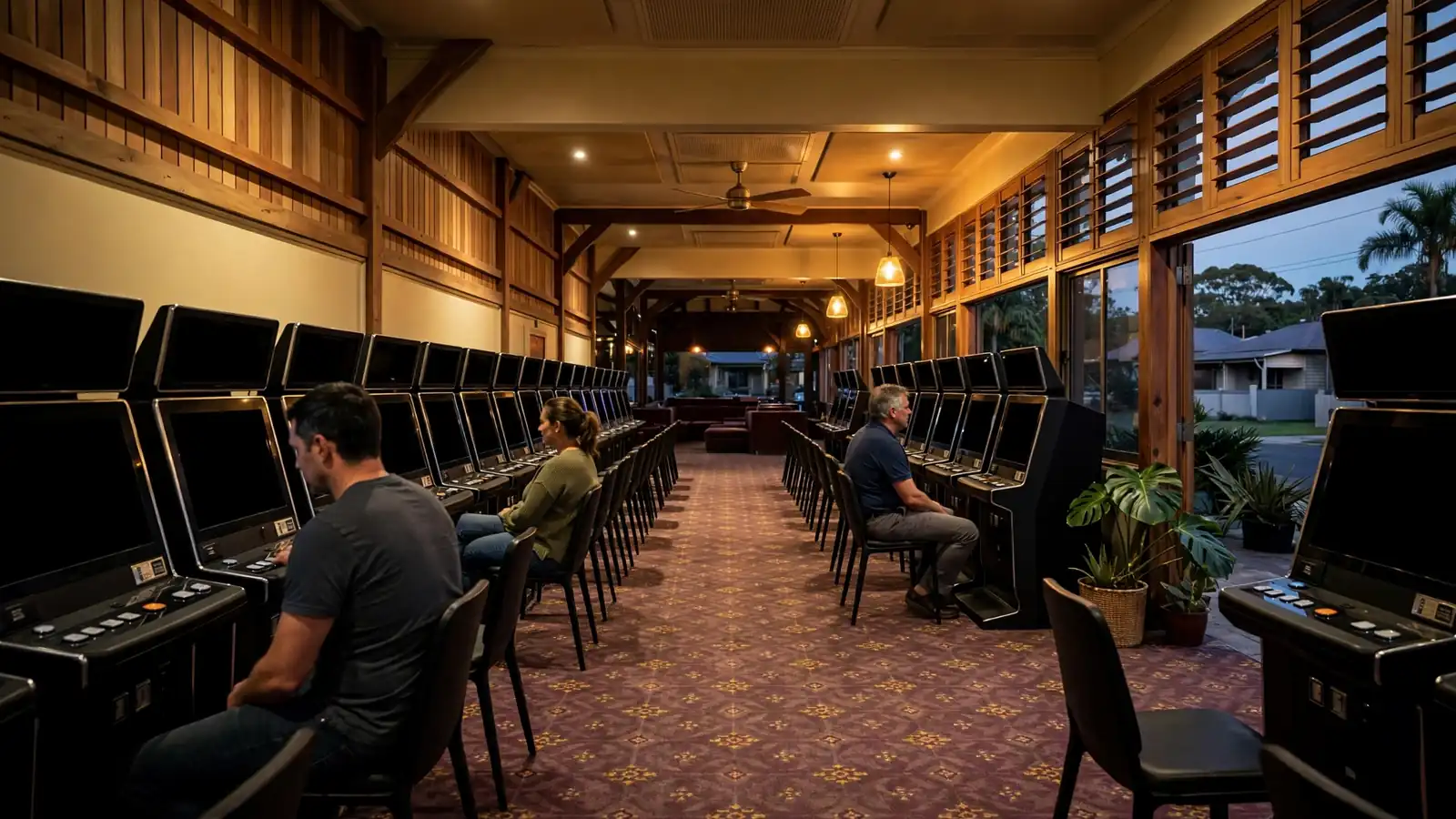
The legal position helps explain the distinction. Under the Interactive Gambling Act 2001, operators cannot lawfully provide real-money online pokies to people in Australia without a domestic licence. No domestic online casino licences have been issued. That does not turn an RTP figure attached to an offshore game into an Australian standard; it means the market label cannot establish that the figure has been set or approved by an Australian online casino regulator.
There is another complication at game level. A specialist review reports that some providers let casinos choose between multiple RTP settings for the same pokie. If that configuration applies, the game’s title alone does not identify the return percentage in use at a particular casino. Two versions of a game with the same name may therefore display different figures. The practical detail is the setting, not the national label.
This is where promotional wording can blur categories. “Australian” may describe the intended audience or the site’s presentation, while “RTP” refers to a game setting. Neither word, on its own, proves that a single domestic rate exists. Nor does the label establish that every casino offering the game uses the same configuration.
I have seen how a neat market label can make a page look more definite than the underlying arrangement. The wording creates a sense of uniformity; the operational detail may be casino-specific. A percentage attached to a pokie still has to be read as a claim about that particular game configuration, rather than as a rule applying across Australia.

So the phrase can identify the subject: return percentages for pokies encountered in an Australian context. It cannot, by itself, name a national benchmark, confirm one shared setting, or show that a domestic online casino has authorised the game. Those are separate claims, and the label does not settle them.
Pokies RTP: The Role of Randomness
A pokie’s return percentage describes a long-run statistical expectation; it does not function as a schedule for individual spins. The mechanism behind each result is a Random Number Generator (RNG), which determines the outcome independently. That independence is the essential point: a previous result does not set up, improve or worsen the next one.
I have seen players read a run of losses as evidence that a win must be close, or treat a recent win as a sign that the game is “hot”. Both interpretations impose a sequence on events that the mechanism does not use. The RNG does not keep a visible tally of what a player has won or lost and then adjust the next spin to balance the account. A spin is determined on its own.
That also means a sequence can look striking without carrying a message. Several wins close together do not prove that the next spin is more likely to win. Several losses do not make a win due. Human beings are good at finding patterns in short runs; the machine’s independent outcomes do not have to follow the pattern a person expects.
RTP and randomness describe different levels of the same game. The percentage is a theoretical return measure across play over time. The RNG determines each particular result. Confusing those levels makes an aggregate figure look like a promise about the next spin, when it is not one. It also makes past results seem more informative than they are.
Randomness vs RTP
The RTP is a long-run statistical expectation, while the RNG ensures every individual spin is independent.
In operational terms, there is no useful “moment” to wait for based on the spin history. A player cannot infer from a recent sequence that the RNG is about to produce a specific outcome. Nor does a particular result demonstrate that the next one has been changed. Independent means independent.
The distinction is plain, but easy to lose in the pace of play: the percentage belongs to the game’s statistical description; the spin belongs to a single random event. A display of recent outcomes can invite a story, but it does not alter how the next event is determined. No hidden turn-taking.
High RTP Online: Configuration and Oversight
A published return figure can describe a game build without identifying the setting used at a particular casino. A specialist review reports that some providers let casinos choose between multiple RTP settings for the same pokie. The practical consequence is straightforward: identical titles may carry different stated returns on different sites. A game name alone does not establish which setting is in use.
I treat the displayed percentage as a claim about a particular version, not a permanent feature of the title. The distinction matters because a prominent figure can look like a property of the game itself, when the configuration may depend on the casino. If the site does not identify the selected setting clearly, the headline number leaves a basic question unanswered: which version is actually being offered?
This is a configuration issue, not proof that a casino has changed a setting improperly. Nor does a high figure by itself show who selected it, whether the information is current, or how reliably the operator represents the game. Those are separate matters. “High RTP” is a label; the useful detail is the return setting attached to the game at that specific site.

In Australia, that distinction sits within a significant oversight gap. There is no Australian-licensed online casino. An offshore site may display a return figure, but that display does not make the claim an Australian-regulated standard or give it local approval. The number and the jurisdiction are separate pieces of information.
The consequence is not abstract. If an offshore casino refuses to pay winnings, Australian players have no legal recourse in Australia. That does not establish that every offshore claim is false; it does mean the displayed percentage should not be mistaken for a domestic safeguard or a remedy if a dispute arises.
I would separate three things when reading an online claim: the game title, the RTP setting said to apply at that casino, and the basis for trusting the operator’s description. The first may be visible in the game lobby. The second needs to be stated for that version, rather than inferred from another site’s listing. The third cannot be supplied by the percentage itself.
Configuration is easy to miss because the title remains unchanged. The number may not. A neat figure, without the setting attached, is incomplete.
How to Read a Claim About the Highest RTP
A claim that a pokie has the highest RTP sounds like a comparison, but the result depends on what is being compared. A figure attached to a game name does not, by itself, establish that every casino offering that game uses the same return setting. A specialist review reports that some providers let casinos choose between multiple RTP settings for a given pokie. The same title may therefore be listed with different return percentages in different places.
How to evaluate “Highest RTP” claims
To be meaningful, a superlative claim must specify the comparison set: which games are being compared, at which specific casino, and under which RTP configuration setting.
That changes how a superlative should be read. “Highest” needs a defined comparison set: highest among which games, at which casino, and under which setting? Without those details, the wording may describe one configuration rather than the game in every version available. It may also be a statement about the items included in a particular comparison, not a universal record.
I have seen how a clean headline can flatten a complicated condition. The comparison looks decisive; the configuration detail is what gives it meaning. A figure can be correctly stated for one version while being a poor basis for assuming that another casino offers the same version. The distinction is small in the wording and large in the conclusion.
A useful claim should make the relevant game and setting identifiable, and state the scope of the comparison. If that information is absent, the superlative cannot be checked from the wording alone. It does not prove that the figure is false. It means the claim leaves unresolved whether the comparison is like for like.
The same caution applies when two pages show different figures for what appears to be the same pokie. That difference need not mean one page has made an error: the game may be running at a different RTP setting. Before treating one listing as the winner, the setting and the casino offering it have to match the basis of the other listing.
“Highest RTP” is therefore not a stable label attached to a title in isolation. It is a comparison that needs a stated frame. Where that frame is missing, the bold wording carries more certainty than the available detail supports. The headline may attract attention; the setting determines what it actually describes.
RTP in Practice: Limits of the Percentage
An RTP figure is easy to treat as a fixed property of a pokie. In practice, the figure attached to a game may depend on the setting selected for it. A specialist review reports that some providers give casinos a choice of RTP configurations, so the same title can carry different stated returns at different sites. A percentage copied from one listing, then, may not describe the version offered elsewhere.

That makes the source and context of a figure part of its meaning. A number without a clear link to the particular game configuration tells little about the version in front of a player. The title alone does not settle the question, and a prominent figure in promotional material is not enough to establish which setting applies. The configuration matters.
Then there is the spin itself. A pokie uses a Random Number Generator to determine each result, with every spin standing as a separate random event. The RTP setting does not direct that mechanism to produce a particular result, nor does it make the next outcome follow from the previous one. Two players using the same configuration can therefore see very different sequences.
These limits work together. A return percentage may first be mismatched to the actual configuration; even when it is correctly identified, it still does not describe what will happen in a particular session. Confusing those issues can make a number seem more precise than it is. One concerns which version is being played. The other concerns the random result of each spin.
I have seen how a single clean percentage can do a lot of work in a sales pitch. It looks like a direct comparison, while the underlying setting may be unclear and the outcome remains unpredictable. Treat the figure as a characteristic of a specified configuration, not as a forecast for an individual run. If the configuration is not stated, the percentage cannot carry the comparison on its own.
The practical point is modest: establish which setting the figure refers to, then keep its limits in view. A matching setting does not turn probability into a schedule. And a number without a setting is incomplete.
Are online pokies legal for Australian players?
Operators cannot lawfully offer real-money online pokies to Australians without a domestic licence, and none have been issued. The restriction targets operators, not players; Australians can legally play on offshore sites that accept them, but have no legal recourse in Australia if one refuses to pay.
What is the legal age for online gambling in Australia?
You must be at least 18 years old to gamble online in Australia.
Can casinos change the RTP of their games?
Yes. Some providers allow casinos to choose from multiple RTP settings for a game, so check the specific version and setting offered by the casino rather than relying on the game title alone.
What is the cost-benefit calculation of casino promotions?
Compare the bonus with the wagering requirement: a $500 bonus at 40x requires $20,000 in bets before you can withdraw winnings. If the requirement applies to a $500 deposit plus a $500 bonus at 35x, it requires $35,000 in bets; also check for limits on free-spin winnings.
Created by the ”Supabet Casino” editorial team.